Exploring the Relaxation Landscape of a 2D Quantum Magnet on a 256-Qubit Processor

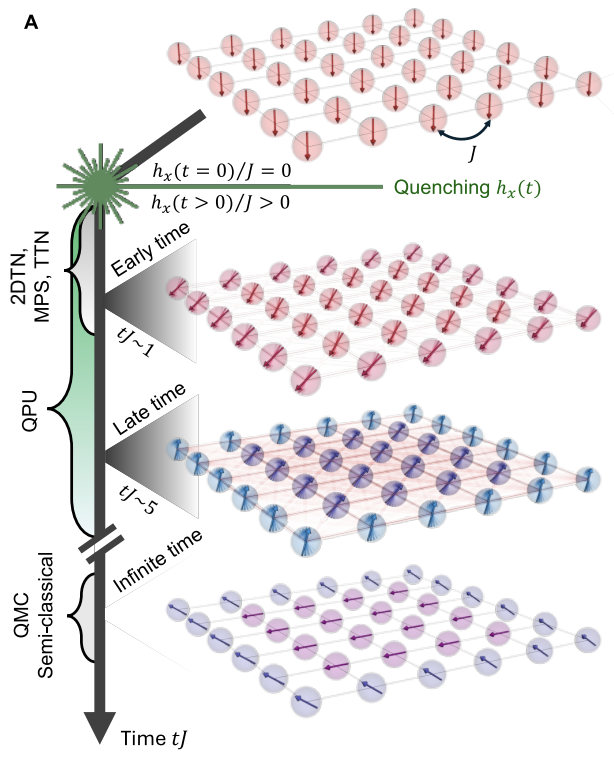
How quantum matter relaxes far from equilibrium is a central open problem in many-body physics, and one for which analog quantum simulators are well positioned to move from confirming theory to discovering new physics. Here, we use a two-dimensional Rydberg atom array of 256 qubits to map the relaxation landscape of the two-dimensional transverse-field Ising model across its phase diagram. Beyond the expected rapid thermalization, we identify two further regimes. The first is a prethermal regime whose dynamics are governed by an effective XY model. The second, and most unexpected, is a crossover regime characterized by a slowdown in relaxation. This slowdown occurs precisely where state-of-the-art classical tensor-network methods lose control at late times, whereas the quantum simulation remains consistent across system sizes. These results establish Rydberg atom arrays as a platform for scientific discovery in nonequilibrium quantum many-body dynamics.